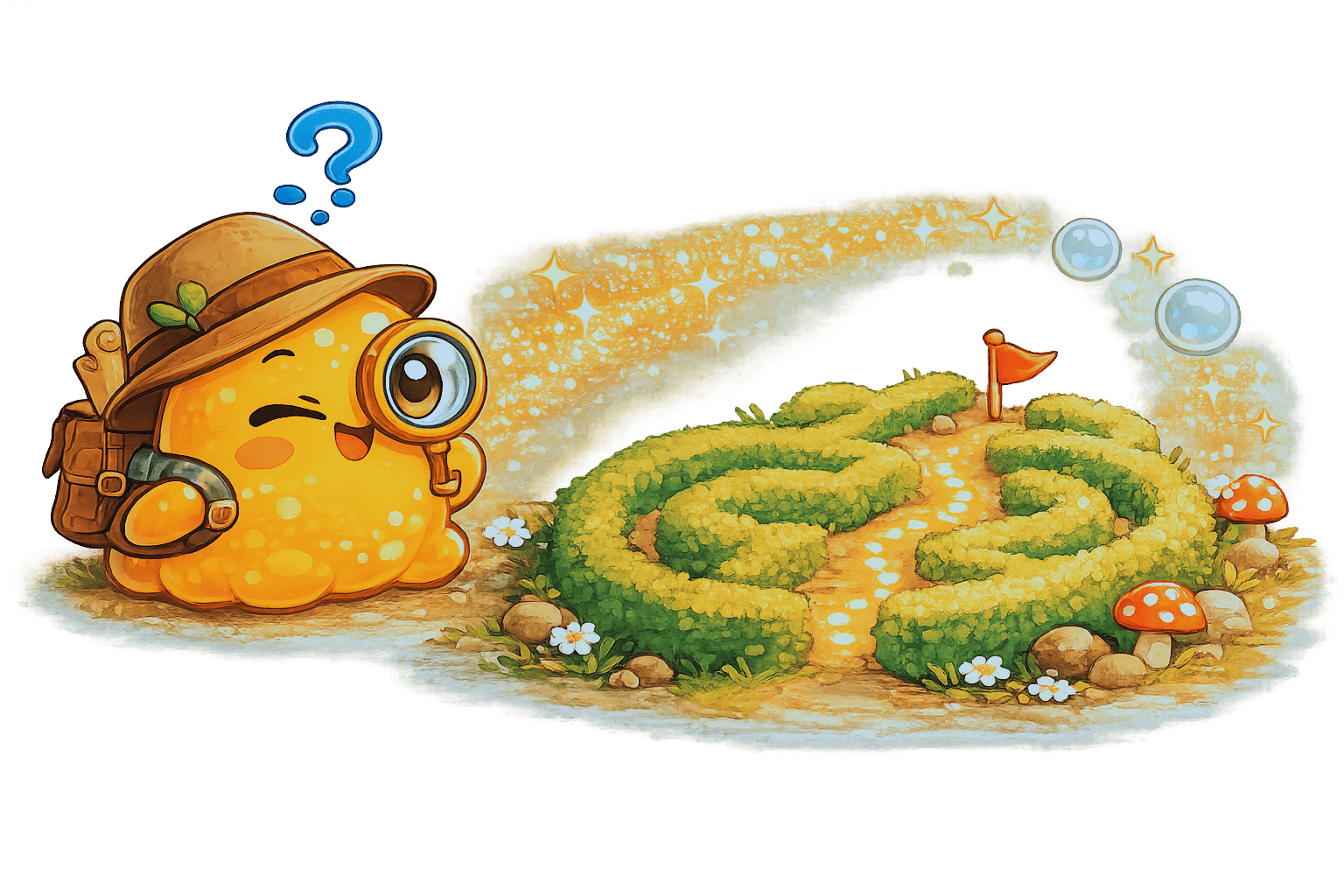
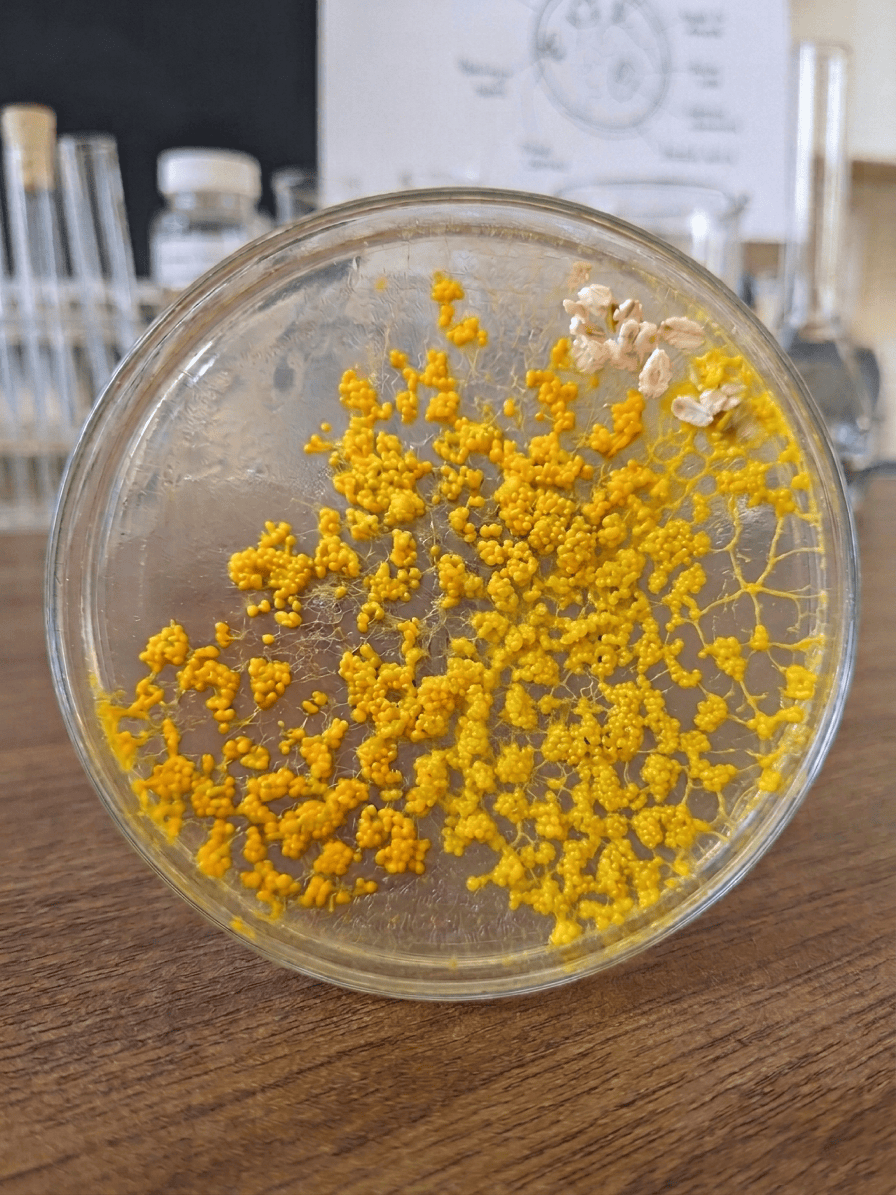
The blob, known scientifically as , is a living organism that defies classification: neither animal, plant, nor fungus. It belongs to the , a group apart that has fascinated biologists for centuries. What makes it truly strange? It is made of a single cell, yet that cell can reach several square metres. Imagine a giant capable of moving, exploring its environment, memorising routes and even solving mazes... without a brain, without , without anything we normally associate with intelligence. This is why it interests biologists and computer scientists alike: the blob optimises its paths with an efficiency that outperforms our . At NeoBloby, it is delivered as , in its natural dormancy state, perfectly stable for shipping and storage.
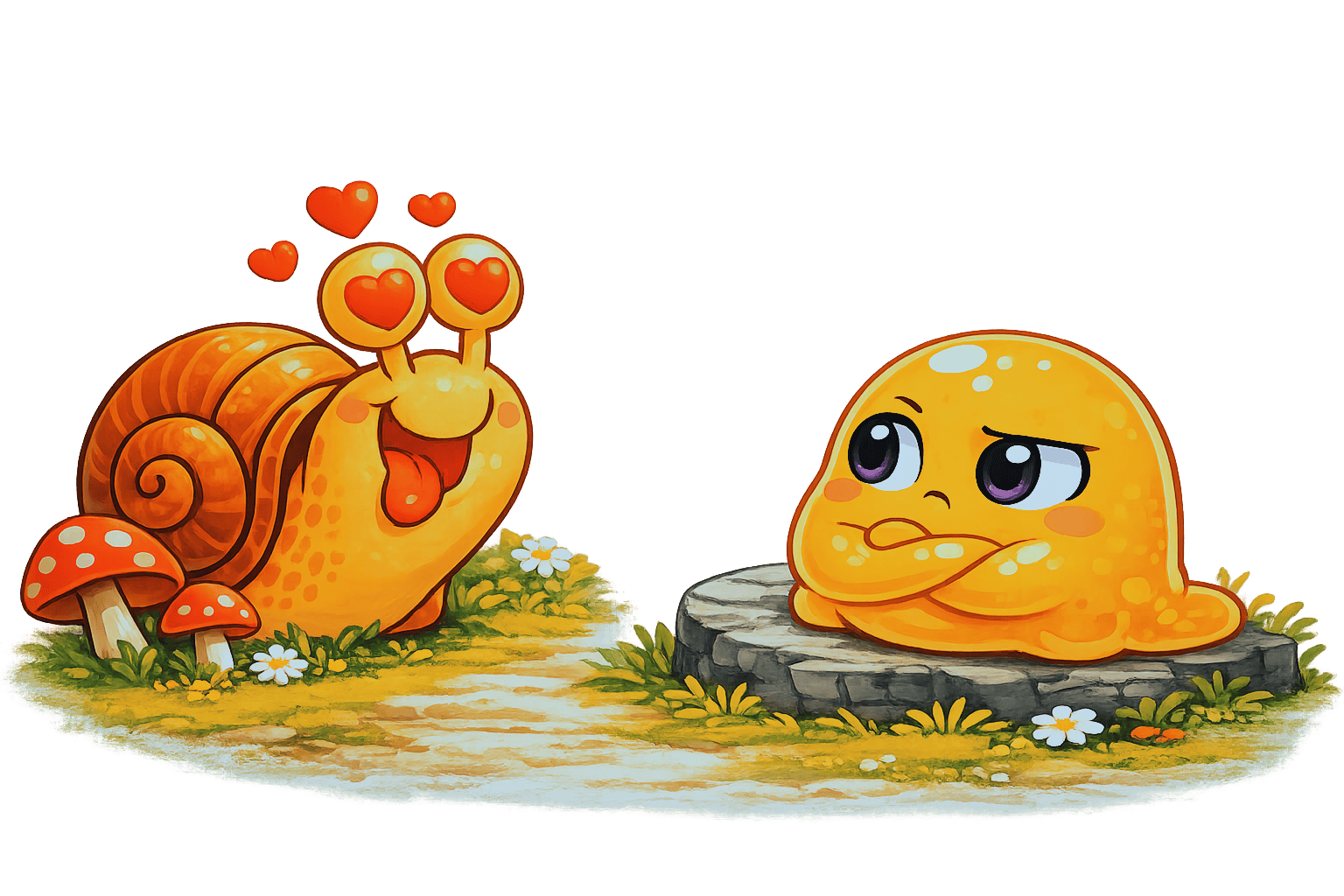
No. The blob is harmless to humans, children, pets and plants. It produces no known toxins and can be handled without any problem, including in class or in a laboratory. You could even eat it, but it is not very tasty - a bit floury. Snails, however, love it... but we do not quite share the same palate.
The kit is recommended from age 10 for independent use. Between 7 and 9, it works very well under adult supervision, often a wonderful opportunity for shared curiosity.
In theory, indefinitely. The blob can be divided, cultured, put into dormancy and revived an unlimited number of times. Some laboratory have been kept alive for over 50 years. In active phase it can live for weeks to months. Dried as , it can remain viable for several years, ready to revive at the first drop of water. A well-maintained, regularly divided blob never truly dies: it perpetuates itself. It is, for all practical purposes, quasi immortal !!
Yes, but it is rarer than you might think. The main causes of irreversible death are: excessive heat (above 35-40 °C), sudden while active, massive or , or direct contact with chemical products (soap, disinfectant, alcohol). A motionless, dried or whitish blob is not necessarily dead: it is very often simply dormant. Always try rehydration before giving up.
Yes, and it is even recommended to encourage growth. The blob feels no pain and closes back up within minutes. You can divide a large blob into several pieces to populate multiple boxes, or remove a portion and put it into form to store it. Two fragments of the same blob recognise each other and merge immediately when brought back into contact.
It depends. Two pieces of the same blob merge straight away. Two different blobs may either merge, ignore each other, or repel each other. It can also happen that one blob covers its neighbour and ends up consuming it. This is one of the most fascinating phenomena of the blob.
A faint earthy or woodland smell is perfectly normal when the blob is active: it is its at work. However, a strong, acidic or putrid odour may indicate a . In that case: remove any uneaten food, transfer the blob to a clean and increase ventilation. If the smell persists or the blob's condition worsens, isolate it quickly and consider putting it into dormancy.
Under optimal conditions, a blob can spread over several tens of centimetres, and well beyond that. There is no fixed limit: as long as it is fed and space allows, it keeps growing. In laboratory settings, some specimens have covered surfaces of several square metres. To keep it manageable at home, divide it regularly and put the excess into form.
Place the on a moist (lightly dampened filter paper), put it somewhere dark at 20–25 °C, and cover with a lid pierced with 1–2 small holes. Wait 12–24 hours: the first yellow will appear spreading from the edge of the sclerotia. Do not disturb anything during this phase, light slows or blocks the awakening.
Check in order: temperature (minimum 21–24 °C; below 18 °C the blob is almost motionless), humidity ( moist to the touch, not waterlogged), darkness (even indirect light can inhibit waking), and patience (some take up to 48 h). If after 48 h in good conditions nothing happens, contact us with a photo.
Yes, but with caution. The fridge (4-8 °C) drastically slows the blob without killing it, which can be useful to slow down an overly active culture. Never put an active, moist blob directly into the fridge: dry it gradually first, as condensation encourages bacteria. For , room-temperature storage in a dry, dark place remains the simplest method.
The ideal should be smooth, slightly porous on the surface and sufficiently absorbent. is the reference: firm, moist, perfect for experiments. Filter paper works very well for everyday use. Non-woven polypropylene fabric (, ~17 g/m²) is a durable alternative, easy to cut and reuse. Avoid kitchen paper and any overly porous in which the blob becomes embedded, as well as any chemically treated surface.
The blob is a decomposer that digests microorganisms. In captivity the best foods are: plain uncooked oat flakes (the reference food), rice bran, cornflour (maïzena), a small amount of brewer's yeast, and cooked pasta (e.g. macaroni). Strictly avoid organic or bulk-bought oats: they can carry wild fungal spores - more aggressive, less pretty and far less docile than the blob - that contaminate the culture very quickly.
Every 1 to 2 days is enough when the blob is active. Place a small amount directly on the . Do not overfeed: if food remains uneaten after 24 h, the blob has had enough or conditions are not optimal (too cold, too wet, too bright).
No. The blob appreciates (oats, rice, maize) and yeasts. It avoids or tolerates very poorly salt, excess refined sugar, oils, spices, caffeine and any chemical product. Remarkably, experiments have shown the blob can learn to cross zones containing repellent substances once it has recognised them as harmless after repeated exposure.
Most of the time, it is not the blob that is the issue but food left too long in the enclosure. Oat flakes can start to and give off a sour or rancid smell in less than 24 h. To avoid this: always remove uneaten leftovers after 24 hours, and only add small quantities at a time.
The optimal range is 20–26 °C. Below 18 °C: almost motionless. Between 18 and 20 °C: active but sluggish. Above 28 °C: stressed, tends to enter premature dormancy. Beyond 35 °C: risk of irreversible death. In winter, keep it in the warmest room in your home, away from draughts.
The blob avoids light. In bright conditions it slows down, stops moving, or may spontaneously begin to enter dormancy. For optimal growth, keep it under an opaque cover or in a cupboard. Light can intentionally be used to slow it down or redirect it in experiments.
Any sealable, airtight container works, provided you pierce a few small holes in the lid for ventilation. Food storage boxes (Tupperware-type) are ideal. Petri dishes are perfect for experiments. Avoid metals and containers treated with antibacterial coatings.
Yes, but be careful not to confuse "moist" and "waterlogged". The blob needs a slightly moist at all times: too much standing water encourages . is particularly effective at maintaining stable moisture. Mist with mineral or filtered water. Tap water can be used if it has rested for 12 to 24 h. Avoid very hard water.
Yes, regularly. Food remnants and old accumulate and encourage or fungal growth. The simplest method: transfer the blob to a clean substrate in a fresh box, then wash the old one with hot water and no soap. Avoid any disinfecting or antibacterial product: even a trace can kill the blob.
Stop feeding the blob 24 h in advance. Remove the lid to gradually reduce humidity. The blob will naturally retract, densify and shift from bright yellow to beige/brown. Once fully dry (24 to 48 h depending on size), it is ready to store. Make sure it is on a smooth before for a clean harvest.
Put the blob into dormancy before leaving: stop feeding it 24 h before departure and let it dry gradually (lid open). Once in form, you can leave it for weeks or months without any problem. On your return, rehydrate it on a fresh . This operation can be repeated indefinitely without harming the blob.
A properly dried and stored remains viable for several years. Ideal conditions: dry, away from heat (below 25 °C), direct light and excessive ambient humidity. All sclerotia sold on neobloby.com are produced and packaged under these conditions.
It is often impossible to tell with the naked eye, and that is precisely why you should never jump to conclusions. A dead blob and look very similar: dry, inert, with no vivid colour. The only reliable test: place it on a moist at 20-25 °C in the dark. If yellow filaments appear within 12 to 48 h, it was alive. If nothing happens after 48 h under good conditions, it is probably dead. If in doubt, contact us with a photo.
Remove all uneaten food immediately (this is almost always the source). If contamination is localised, move the blob to a clean taking only the healthy part. If it is widespread, put the blob into emergency dormancy. To prevent recurrence: ventilate more, do not overfeed, and use industrially produced oat flakes (not organic, not bulk).
Several possible reasons. The food may be badly placed: always put it on the , never behind it. It may be too dry: lightly moisten the flakes before placing them. The temperature may be too low: below 20 °C, the blob's appetite drops noticeably. Or it has simply just eaten well: wait 24 h before offering food again.
The blob explores when it lacks food or conditions are unsuitable. Solutions: place the box in a larger tray (the blob avoids free water), create a fine salt barrier around the box (the blob will not cross salt), or feed it more regularly to reduce its exploratory instinct. If the blob becomes immobile despite this, check the freshness of the flakes and the conditions: it often reacts to stale food or a temperature that is too low.
A bright yellow blob is in good health. A blob that fades may indicate spontaneous dormancy (lack of food, unfavourable conditions), the start of or an ongoing . In all cases, start by re-moistening the : that is often enough. If it remains white and completely motionless for more than 48 h despite good conditions, transfer it to a fresh substrate to test its reactivity.
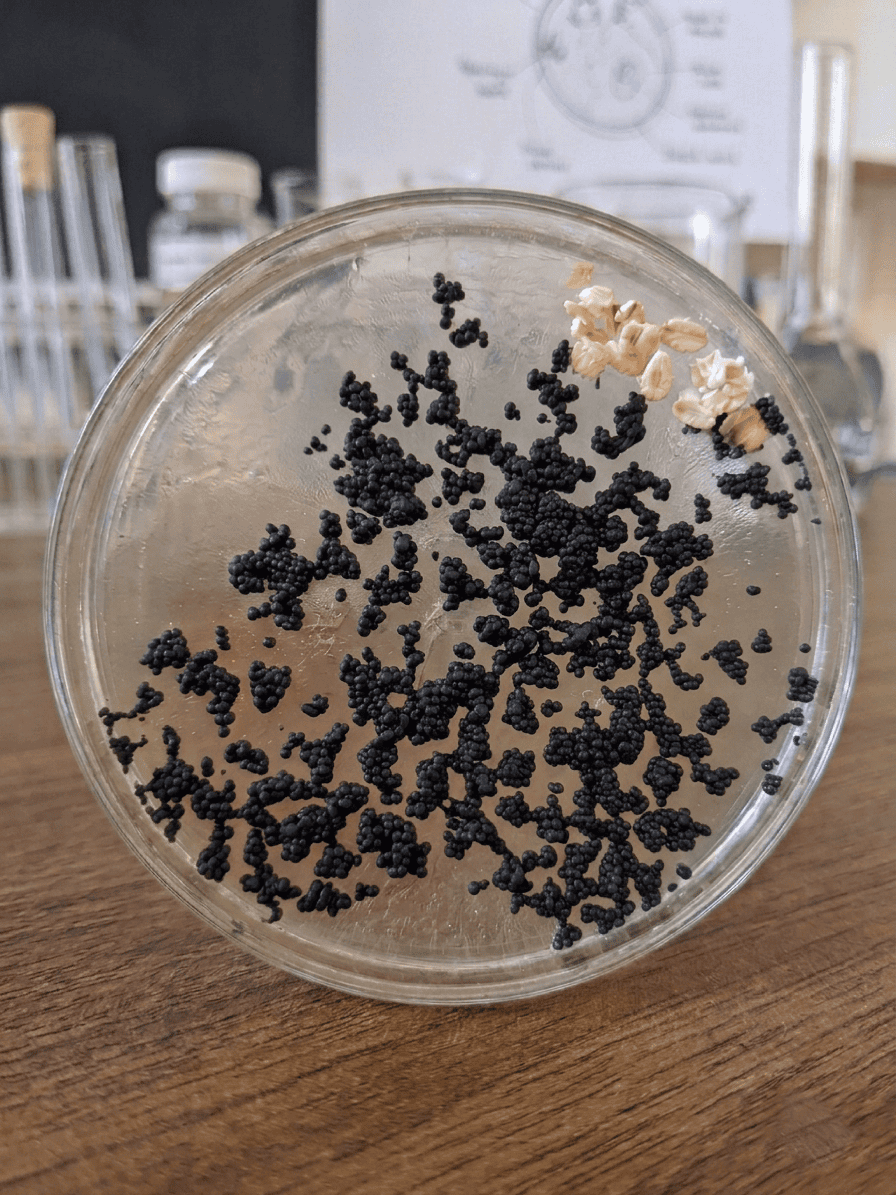
Yes, this is : a natural phenomenon, often triggered by prolonged stress (too much light, heat, lack of food or insufficient humidity). The blob forms small stalks topped with golden or dark-brown capsules.
If the capsules are already visible like this, sporulation has started and won't stop: no need to panic, but it's already too late to save this particular blob - it will be replaced by the spores. Nothing is wrong, and it's not a mistake on your part: it's a natural life cycle running its course. Once sporulation is complete, very little of the blob remains.
For a future blob, the only window to prevent it is before the stalks appear, at the very first signs of immobility: reduce light exposure, check that the substrate stays moist, and feed it if needed.
BeforeAfter
is not simple dormancy: the transforms into and disappears. Unlike a , the original blob does not come back. Reviving the same blob after sporulation: no. Getting a new blob from the spores: theoretically possible, but much harder to achieve at home.
Crushing a well-ripened black ball releases a dark powder of and capsule debris. These spores do not produce an instant blob: they must first germinate into forms invisible to the naked eye, then compatible cells must fuse to reform a new : a fragile, slow and unpredictable process, very different from waking a .
To preserve your strain, it is better to avoid sporulation from the first signs of stress: too much light, heat, lack of food or moisture. Correct conditions quickly or induce proper dormancy as a before the blob switches to reproduction.
The blob has no "reset" button, the little rascal..
Your order contains dried of , cut into approximately 1 cm squares. Each square is a complete blob, capable of waking up and growing entirely on its own. The quantity delivered depends on the option chosen at the time of ordering.
Neobloby ships to the 34 countries in our Europe zone: the entire European Union, as well as the United Kingdom, Switzerland, Liechtenstein and the European microstates (Andorra, Monaco, San Marino, Vatican City). Other destinations may be available, check the options at checkout or contact us for any specific request.
Orders are prepared within 1 to 3 business days. Delivery then takes 2 to 5 working days depending on your location. You will receive a confirmation email with a tracking number as soon as your order is dispatched.
The are shipped dry, in protective packaging suited to transport. In this state, they are not sensitive to standard postal delays or the moderate temperature variations encountered during transit.
Completely normal. In dormancy, are dry, inert and have no "living" appearance, they look like small pieces of beige or brown matter. This is exactly their natural preservation state. Follow the waking protocol and the first yellow will appear within 12 to 48 h.
At Neobloby we guarantee the awakening of our under normal conditions of use. If your blob has not woken up after following the protocol for 48 h, contact us with a photo and a description of conditions (temperature, , humidity). We will find a solution: replacement or refund as appropriate.
Yes, and it is one of our favourite uses. The blob is an exceptional educational tool for biology lessons, science workshops or class projects. For bulk orders or educational projects, contact us directly to discuss a tailored offer.
Our are produced in France from the CNRS AVA (Badhamia variety, Physarum polycephalum), selected and maintained. Every batch is checked before dispatch. Neobloby is a specialist operation: the blob is our core business, and we are available to support every customer, beginner or experienced alike.
NeoBloby is a based in France. It benefits from the French , which means it invoices without and states this clearly on its invoices. For sales to other EU countries, NeoBloby may also benefit from the introduced by Directive 2020/285. This requires staying below both the EU-wide ceiling of €100,000 and each individual country's own threshold. If all conditions are met, the business receives an allowing it to apply the local exemption rules. In short: no VAT at NeoBloby, no surprise on your invoice.
💌Didn't find your answer?
Our team is here to help! Don't hesitate to contact us directly.