


1822 - The Blob Enters History
The NeoBloby Team · July 31, 2026 · 3 min de lecture
Mis à jour le August 10, 2026
Key takeaways
- In 1822, naturalist Schweinitz spots a yellow mass growing on dead wood and producing spores - with the tools of his time, everything points to a fungus, so he formally describes it as Physarum polycephalum.
- Two centuries later, modern microscopes and genetic analysis flip the verdict: it's not a fungus but a giant amoeba, a single cell that can move around with no brain and no muscles.
- The name Schweinitz gave it still stands - only the classification changed. Fair enough: back then, something growing on damp wood and releasing spores looked exactly like a fungus.
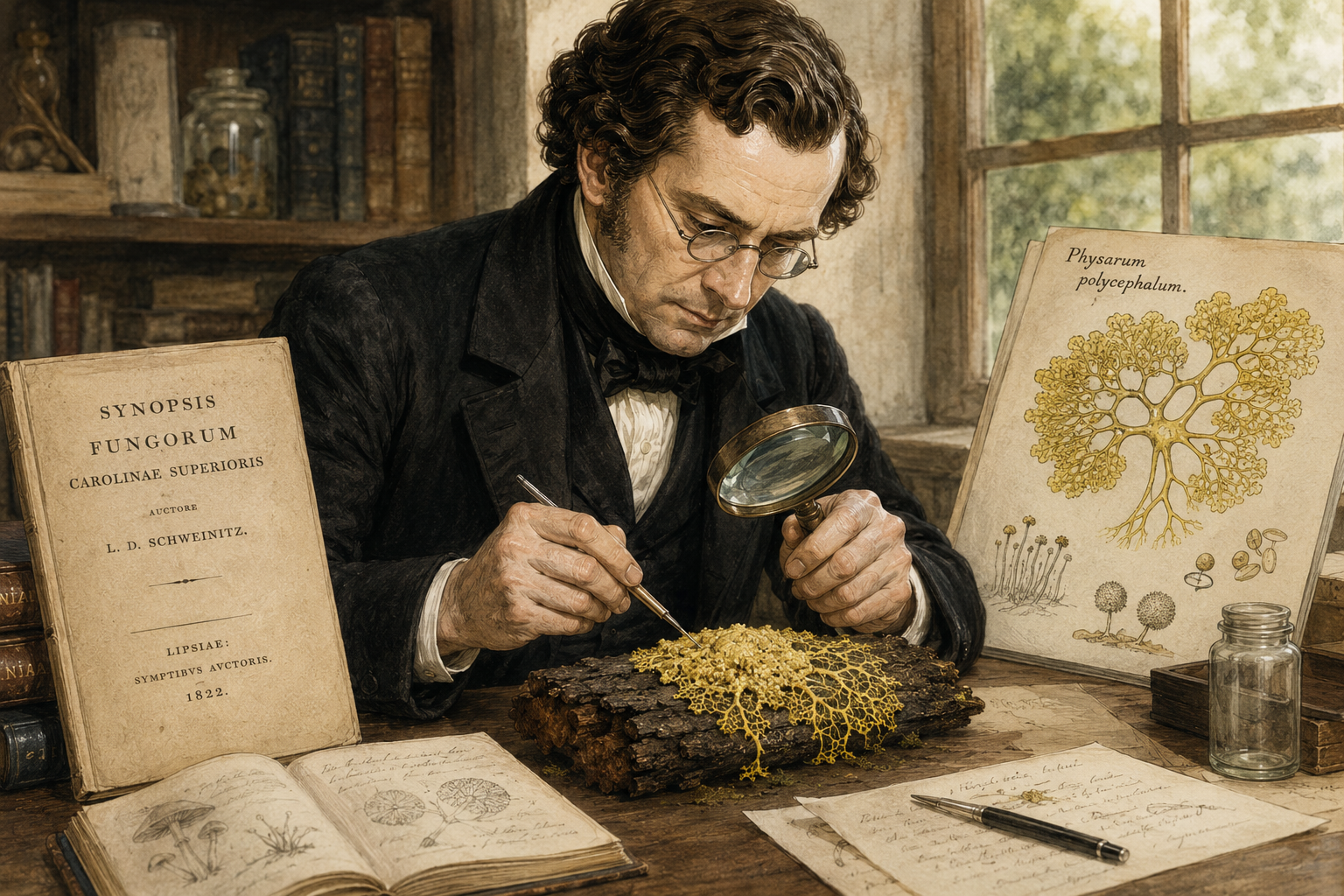
In 1822, naturalist Lewis David von Schweinitz observed a strange creature that lives in damp places, grows on dead wood, and produces spores.
 Portrait de Lewis David von Schweinitz, publie dans Popular Science Monthly (1894, domaine public).
His verdict: it's a fungus.
So he officially described the species under the name Physarum polycephalum. Polycephalum means “many-headed,” which immediately gives this yellow mass - one that moves slower than a tired snail - a bit of a mythological monster vibe.
This publication marked its official entry into the science books.
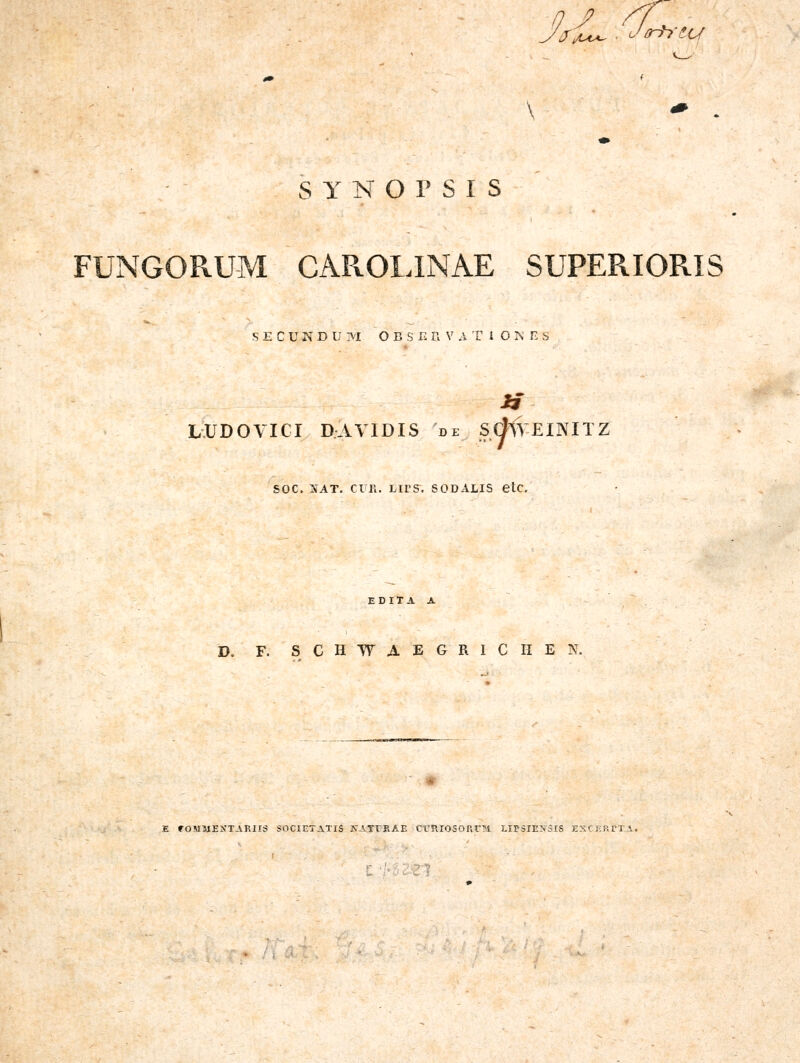 Page de titre de Synopsis Fungorum Carolinae Superioris (1822), l'ouvrage dans lequel Schweinitz decrit l'espece. Source : Internet Archive / Biodiversity Heritage Library.
Fungi don't go for walks
At first glance, Schweinitz's mistake holds up.
The blob likes dark, damp forests. It grows on dead leaves, bark, and decomposing wood. When it reproduces, it also forms small structures that release spores.
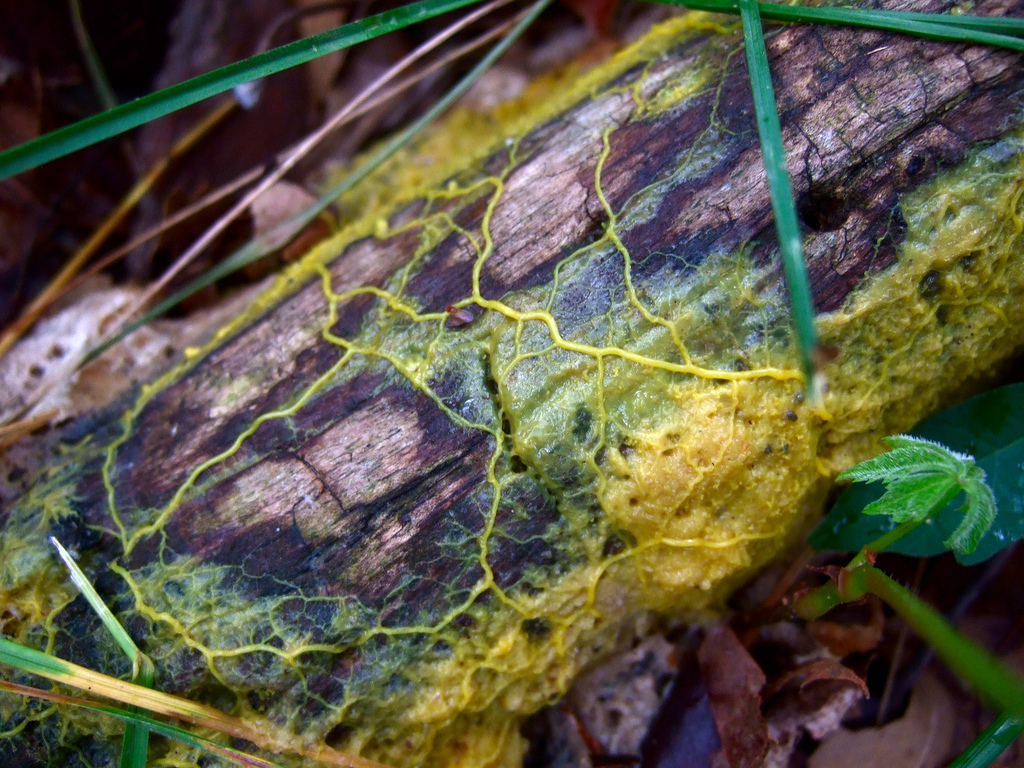 Plasmodium de Physarum polycephalum sur une ecorce, en milieu naturel. Photo : frankenstoen, CC BY 2.5, Wikimedia Commons.
So, fair enough, it checks quite a few boxes on the “fungus” checklist.
Except a fungus doesn't normally go for a stroll to look for its dinner.
The blob, on the other hand, moves by deforming its body. When it finds bacteria, yeast, or microscopic fungi, it surrounds them and absorbs them. No mouth, no teeth, and definitely no tiny fork: its entire membrane takes part in the meal.
In 1969, biologist Robert Whittaker proposed a five-kingdom classification of living organisms and officially moved slime molds out of the fungi kingdom into the newly created kingdom Protista. Microscopic observation, followed by genetic analysis, would eventually sort things out. The blob belongs to the amoebozoa, the vast group of amoebas - not to the fungi.
It's also unicellular, even though it looks more like someone spilled a radioactive omelette in the forest.
One seriously oversized cell
When someone mentions a unicellular organism, you probably picture some microscopic speck you'd need lab equipment to even see.
The blob clearly didn't get the memo.
The yellow shape you see, called a plasmodium, is a single giant cell containing a multitude of nuclei. These multiply, but the cell never splits into separate independent cells. It simply keeps growing and extending its network.
Inside, its contents flow through vein-like channels that contract rhythmically. This mechanism distributes nutrients and pulls the whole mass toward food.
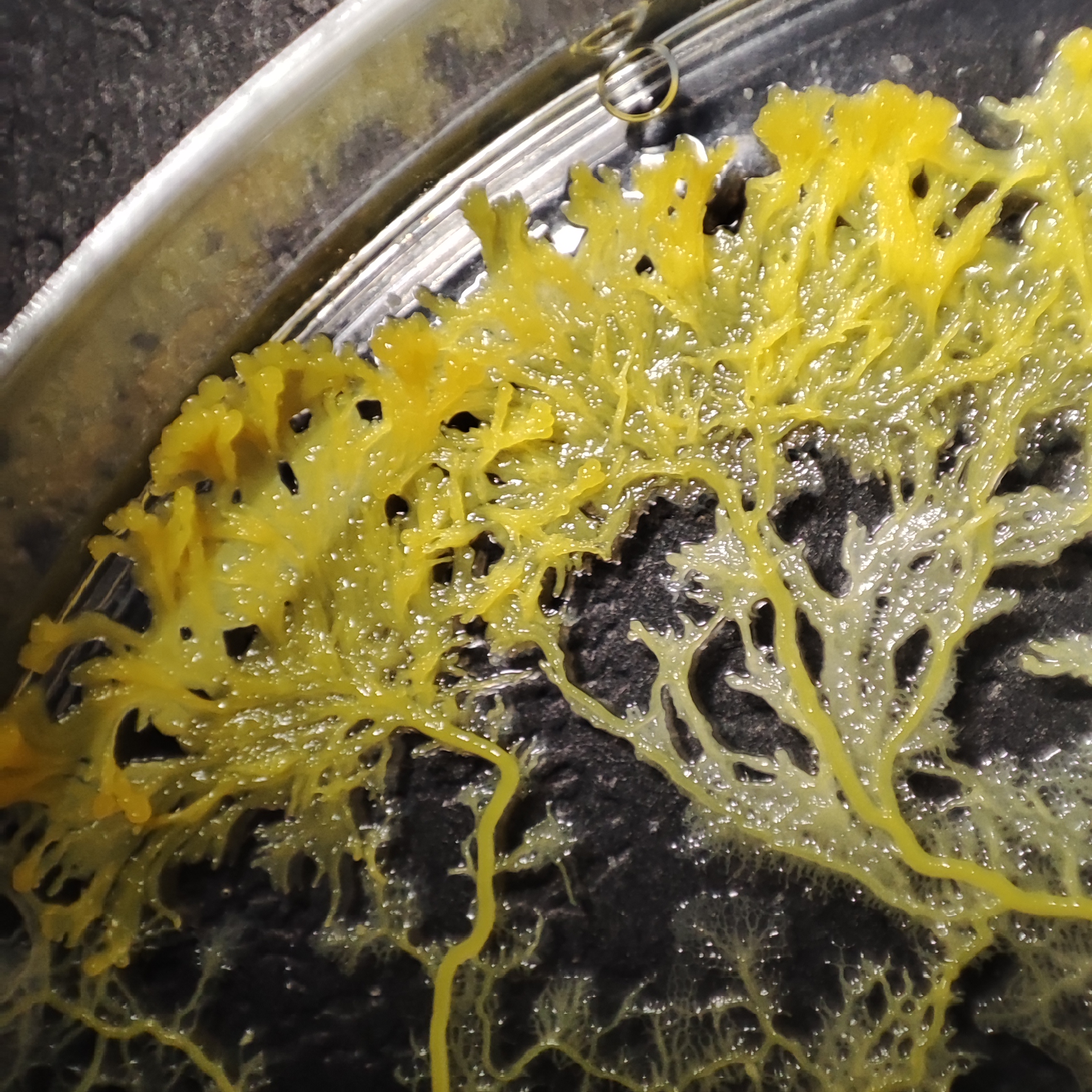 Reseau de pseudopodes de Physarum polycephalum en boite de culture. Photo : Tim Tim (VD fr), CC BY-SA 4.0, Wikimedia Commons.
The blob can thus explore its environment despite having no brain, no muscles, and no nervous system.
Its nickname would come much later, borrowed from the 1958 science-fiction film The Blob, in which a gelatinous mass from outer space lands on Earth and devours everything in its path. The real version is thankfully far less ambitious: a few bacteria, some microscopic fungi, and, in the lab, some oat flakes are more than enough for it.
By thinking he was adding one more fungus to his catalog, Schweinitz had actually just named a giant cell capable of moving, building networks, and adapting its behavior to its environment.
Not bad for a brainless omelette.
- Lewis David von Schweinitz, Synopsis fungorum Carolinae superioris (1822), digitized by the Biodiversity Heritage Library
- GBIF, taxonomic record for Badhamia polycephala, with Physarum polycephalum Schwein., 1822 as the original name
- CNRS Le Journal, “The blob, the Paris zoo's new star”
- CNRS Images, movement and functioning of Physarum polycephalum
- Muséum national d'Histoire naturelle, “What is a blob?”


Ready to welcome your own blob?
Discover our complete rearing kits, designed to watch the blob wake up, feed, and grow at home.
Shop the kits



No comments yet.