



2023 - The Blob Faces the Heatwave
The NeoBloby Team · August 24, 2026 · 2 min de lecture
Key takeaways
- Audrey Dussutour (CNRS, Toulouse) launched the participatory project "Derrière le blob, la recherche," with 3,500 volunteers.
- Two species were tested, Physarum polycephalum and Badhamia utricularis, exposed to heatwaves simulated with an infrared lamp.
- Badhamia showed up to 75% mortality during intense, prolonged heatwaves; Physarum copes better with a gradual rise than with a sudden spike.
- The study's message: it is the intensity and amplitude of heat spikes that threaten these organisms, despite outweighing all animal biomass 32 times over.
The blob hates a heatwave. A researcher in Toulouse has just proven it at national scale: 3,500 volunteers, two blobs per household, and nearly a million photos taken morning and evening over several months.
Audrey Dussutour (CNRS, Toulouse) launched this participatory project in late 2021 under the name "Derrière le blob, la recherche" ("Behind the Blob, the Research"). Each volunteer received two blobs: a control group kept at room temperature, and an experimental group exposed to artificial heatwaves via an infrared lamp. Two species circulated among participants: Physarum polycephalum, the star of the laboratory, and Badhamia utricularis, more common in the wild but less known to the general public.
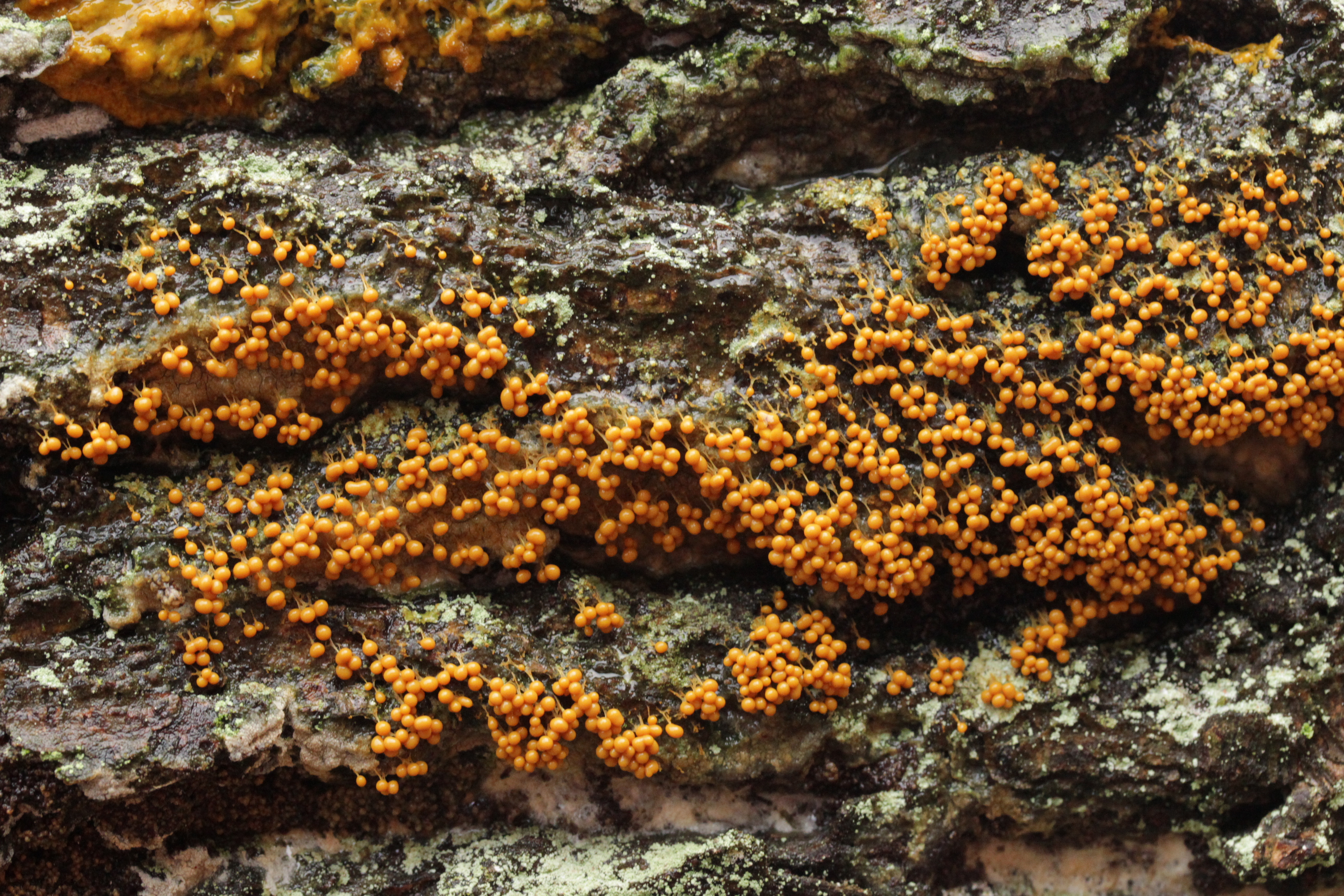 Badhamia utricularis en fin de cycle, formant ses sporocarpes orange sur une ecorce humide. Photo : Bjorn Sothmann, CC BY-SA 2.0, via Wikimedia Commons (Flickr).
First verdict: Badhamia can't take the heat, with up to 75% mortality in the experimental group during the most intense and prolonged heatwaves.
Physarum fares better, but only if the rise is gradual. At a rate of two extra degrees each day, the organism adapts and copes. Faced with a single spike to 30°C arriving all at once, with no gentle ramp-up, mortality climbs much higher.
What matters to the researcher is the amplitude of the peaks: a thermometer climbing from 25°C in the morning to 41°C in the afternoon leaves organisms far less room to adapt than a slightly rising yearly average.
One last point, and not a minor one: Audrey Dussutour is campaigning against the way climate change studies keep overlooking microorganisms, even though they alone account for 32 times the biomass of all animals combined. At the time these first results were unveiled, in September 2023, she was still combing through the nearly one million photos sent in by volunteers, with a scientific publication in view.


Ready to welcome your own blob?
Discover our complete rearing kits, designed to watch the blob wake up, feed, and grow at home.
Shop the kits


No comments yet.