


2010 - The Blob Redesigns Tokyo's Rail Network
The NeoBloby Team · August 10, 2026 · 3 min de lecture
Key takeaways
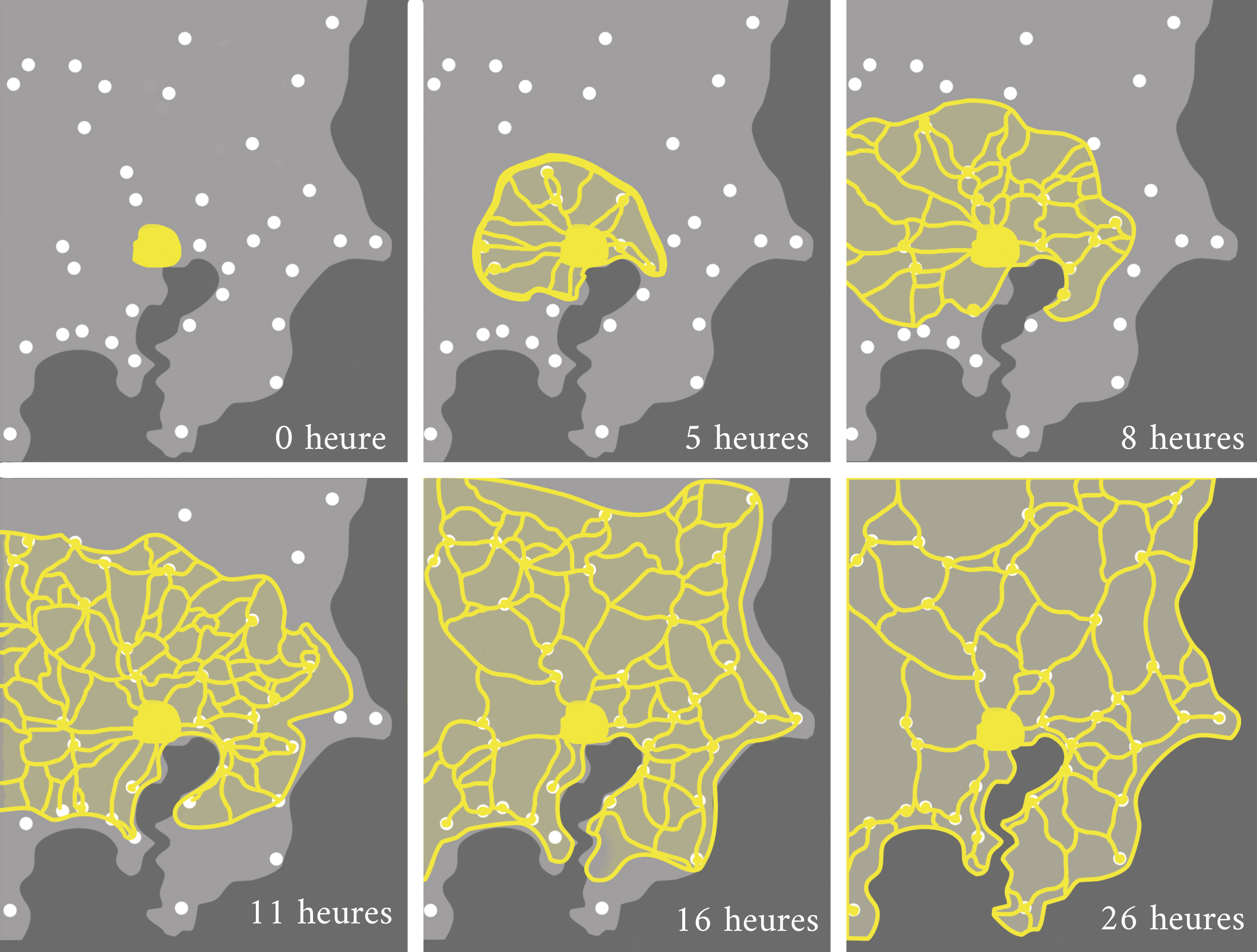
- In 2010, a team led by Atsushi Tero (Hokkaido University), with Toshiyuki Nakagaki and researchers from Oxford, publishes a new experiment in Science: the maze is replaced by a map of the Tokyo region.
- Thirty-six oat flakes mark the surrounding cities, light simulates mountains and waterways (the blob flees it), and within 26 hours the network stabilises.
- Result: a mesh whose cost, efficiency and fault tolerance are comparable to Tokyo's real rail network, built by generations of engineers.
- This behaviour is then translated into a mathematical model, reused since to design resilient telecommunications and infrastructure networks.
Can you design an efficient transport network with no blueprint, no engineer, and not a single neuron? In 2010, a Japanese research team decided to test that question at the scale of a real city: Tokyo.
The project was led by Atsushi Tero, of the Research Institute for Electronic Science at Hokkaido University, in Sapporo. Toshiyuki Nakagaki, already met in our article on the maze from the year 2000, was part of the team, alongside British researchers from Oxford.
On a gel-coated plate, the scientists recreated a map of the Greater Tokyo area. Thirty-six oat flakes marked the location of the main surrounding cities and stations, placed at coordinates matching their real-world counterparts. At the centre, where the capital sits, they placed a plasmodium of Physarum polycephalum, the famous blob.
To simulate terrain, the researchers exploited a well-known aversion of the organism: Physarum flees bright light. So they lit up the areas corresponding to mountains, lakes and coastline, obstacles the blob instinctively avoids, much like a railway line skirts around a mountain range without a tunnel.
In the first hours, the blob spread across the entire available surface, weaving a dense web that connected every food source to every other, indiscriminately. Then it pruned. The least useful connections retracted, the most efficient ones thickened. Within 26 hours, the network stabilised.
The result surprised even the researchers themselves: the resulting topology visually resembled the map of the real Tokyo rail network. But the study went further than a mere visual resemblance: the blob's mesh showed a total cost, travel efficiency and fault tolerance comparable to those of the network built by generations of human engineers.
Published in Science on 22 January 2010 under the title "Rules for Biologically Inspired Adaptive Network Design", the study didn't stop at the anecdote. The team translated the blob's behaviour into a mathematical model, a set of simple rules for reinforcing and weakening connections, able to artificially reproduce this optimisation. That model has since inspired work on designing resilient networks, from telecommunications to road infrastructure.
A single cell, with no brain, had taken just over a day to find, by trial and error, a solution that had taken decades of human planning to build.


Ready to welcome your own blob?
Discover our complete rearing kits, designed to watch the blob wake up, feed, and grow at home.
Shop the kits



No comments yet.