


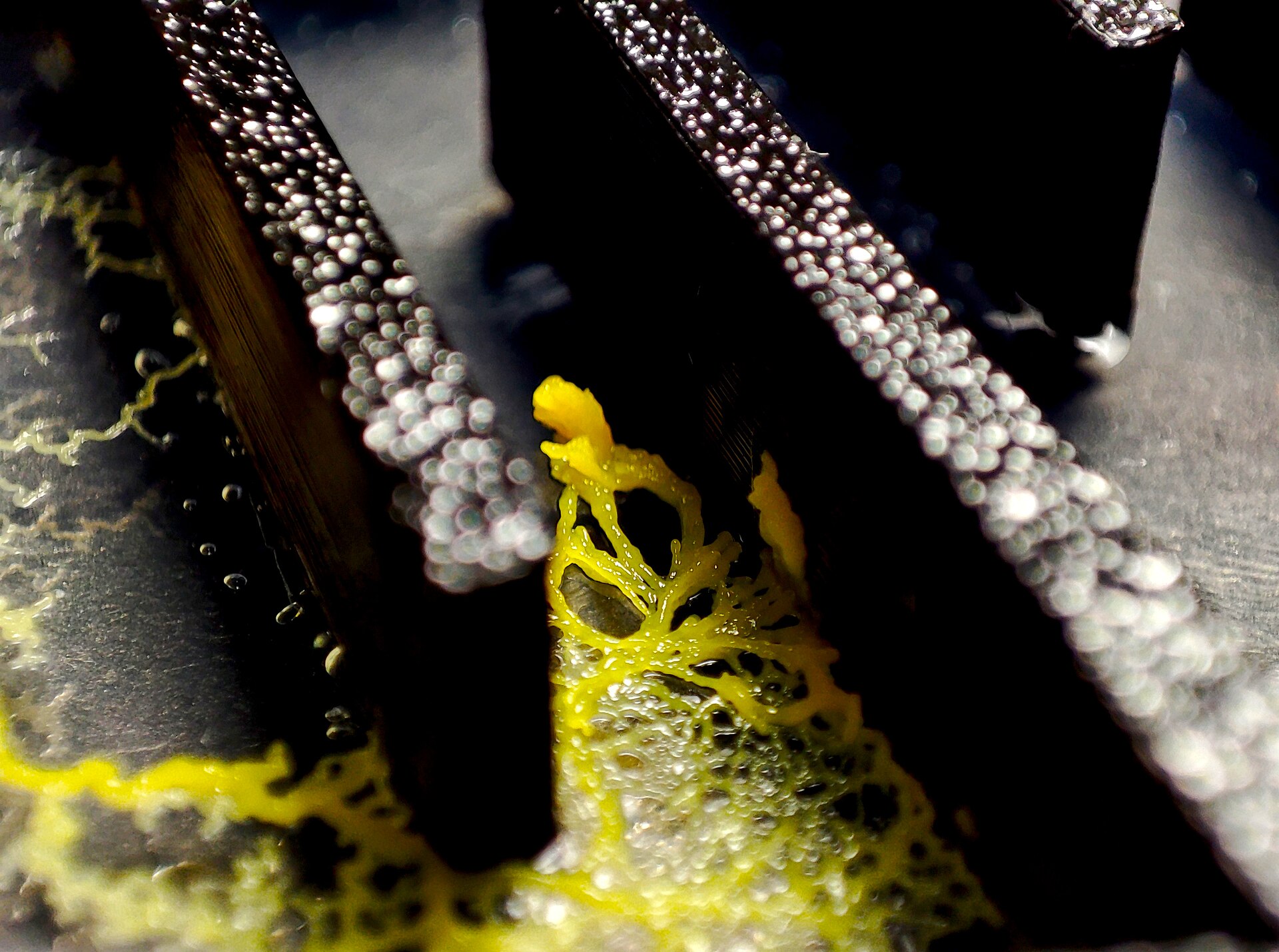
2000 - The Blob Solves a Maze
The NeoBloby Team · August 10, 2026 · 3 min de lecture
Key takeaways
- In 2000, researcher Toshiyuki Nakagaki (RIKEN, Nagoya) publishes a now-famous experiment in Nature: a Physarum polycephalum plasmodium, cut up and reassembled inside a maze with four possible routes, finds the shortest path between two food sources within 8 hours.
- No brain, no neurons: the blob consistently picks the shorter branch when the gap is clear-cut (22%), but hesitates when the gap is only 2%, within the margin of measurement error.
- The discovery earns the team an Ig Nobel Prize in Cognitive Science in 2008, and paves the way for even more spectacular experiments on optimized networks.
Can an organism with no brain, no neurons, and not even the faintest trace of a nervous system solve a maze? In 2000, a lab at RIKEN, in Nagoya, Japan, decided to find out for real.
The scientist behind the question is Toshiyuki Nakagaki. Together with his colleagues Hiroyasu Yamada and Ágota Tóth, he built a 3 cm-wide maze on an agar surface, with four possible routes between a start point and an end point. Nothing a human couldn't handle with their eyes open. Much more interesting for a blob.
That's the (very sober) title of the paper published in Nature in September 2000. A fun detail: Nature filed it under its “Intelligence” heading — a great way to tease everyone before they've even read the first line, for a creature with neither a brain, a tail, nor a head (literally: it can have as many or as few as it wants).
The researchers cut a single Physarum polycephalum plasmodium into small pieces and placed them throughout the maze. These fragments, once in contact, fused back into a single organism, which came to occupy the entire maze, including the dead ends. Two blocks of food (ground oat flakes, as usual with the blob) were then placed at the start and the end.
Four hours after the food blocks were placed, the blob had already started retracting its pseudopodia from the dead ends. Another four hours later — eight hours in total — only a single thick tube remained, connecting the two food blocks by the shortest route. Where the gap between the two possible routes was clear-cut (a 22% difference), the blob systematically chose the shorter one. Where the gap was only 2%, well within measurement error, the outcome was far less decisive: trials split almost evenly between the two routes. The blob doesn't have a flawless GPS, more like a resolution limit, which makes the result more honest than a simple magic trick.
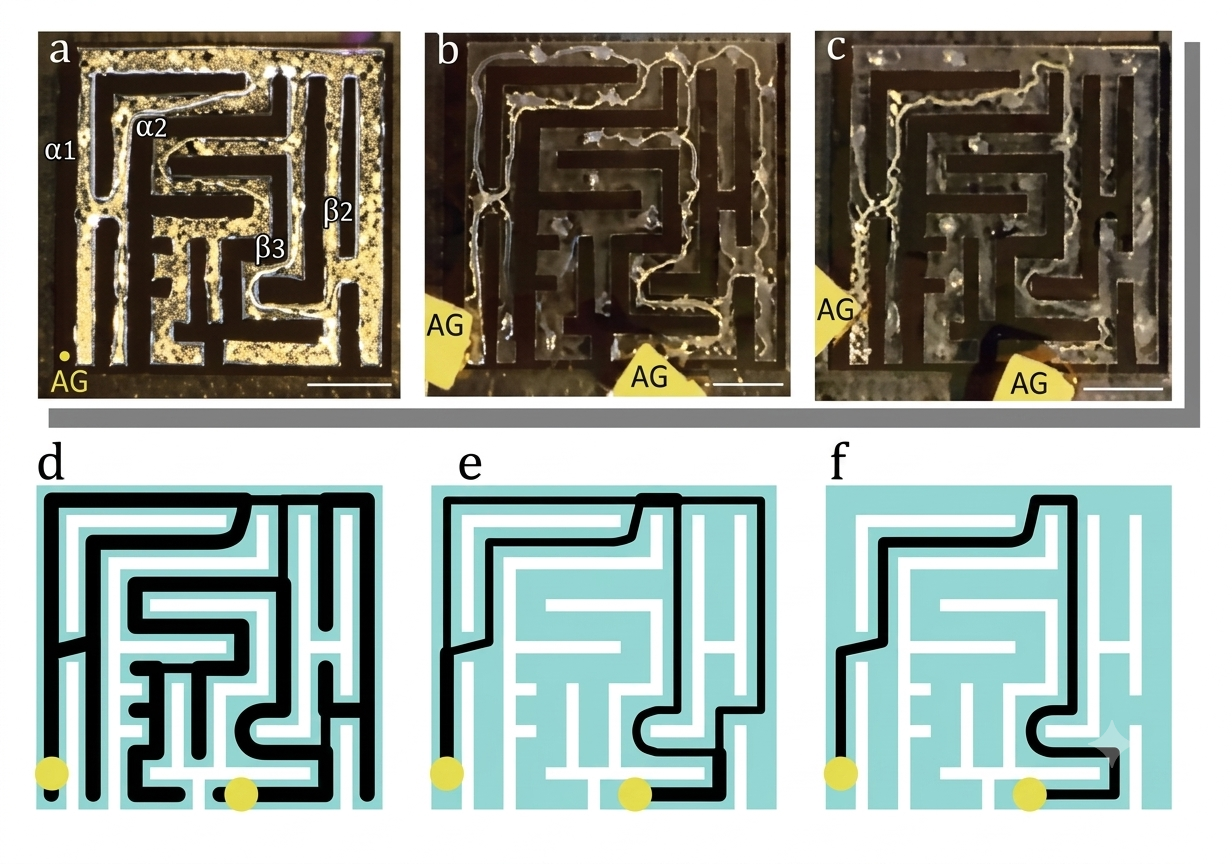 Figure 1 de l'etude originale : panneaux a-c, photos du labyrinthe aux instants successifs (les traces les plus claires marquent le trajet final) ; panneaux d-f, modele mathematique correspondant. Nakagaki, Yamada, Toth, Nature, 2000. Reproduite via le site de recherche d'Atsushi Tero, Institute of Mathematics for Industry, Universite de Kyushu.
In practical terms, that means a giant cell with not a single neuron can compute, through sheer biological trial and error, the equivalent of a shortest-path problem, the very kind computer scientists solve with dedicated algorithms. The blob never took an algorithms class. It just, roughly speaking, stopped watering the branches that led nowhere.
The scientific community took the finding seriously enough to award it an Ig Nobel Prize (the prize that rewards research that “first makes people laugh, then makes them think”) in the Cognitive Science category, eight years later, in 2008. Nakagaki shared the prize with Yamada, Tóth, and three other researchers linked to the follow-up work.
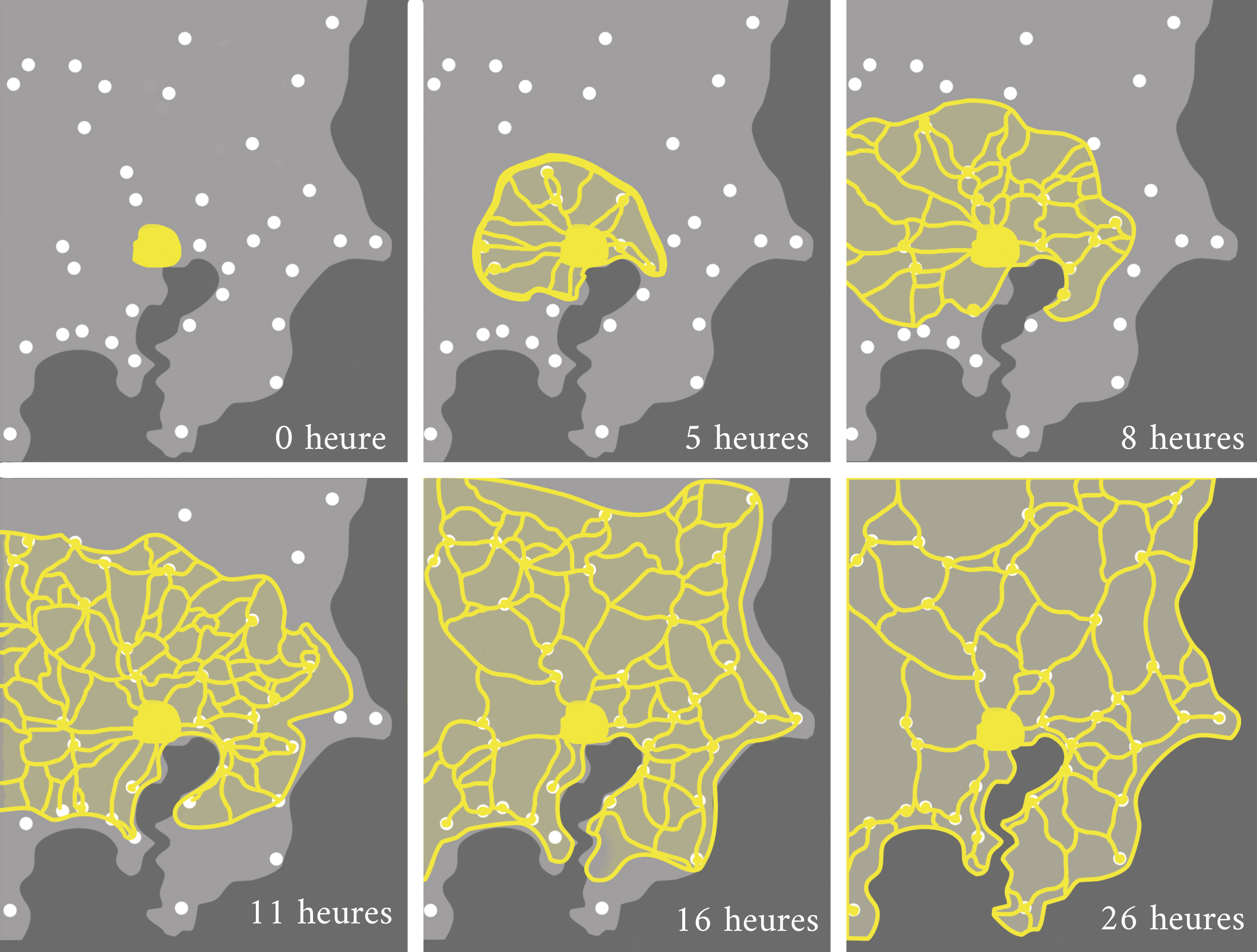
And this is only the beginning of the story: a decade later, the same team would repeat the feat on a whole different scale, swapping the maze for a map of Japan. More on that in a future article.

Ready to welcome your own blob?
Discover our complete rearing kits, designed to watch the blob wake up, feed, and grow at home.
Shop the kits



No comments yet.